

Meshroom
Node-based visual programming toolbox for creating, managing, and executing your data processing pipelines.
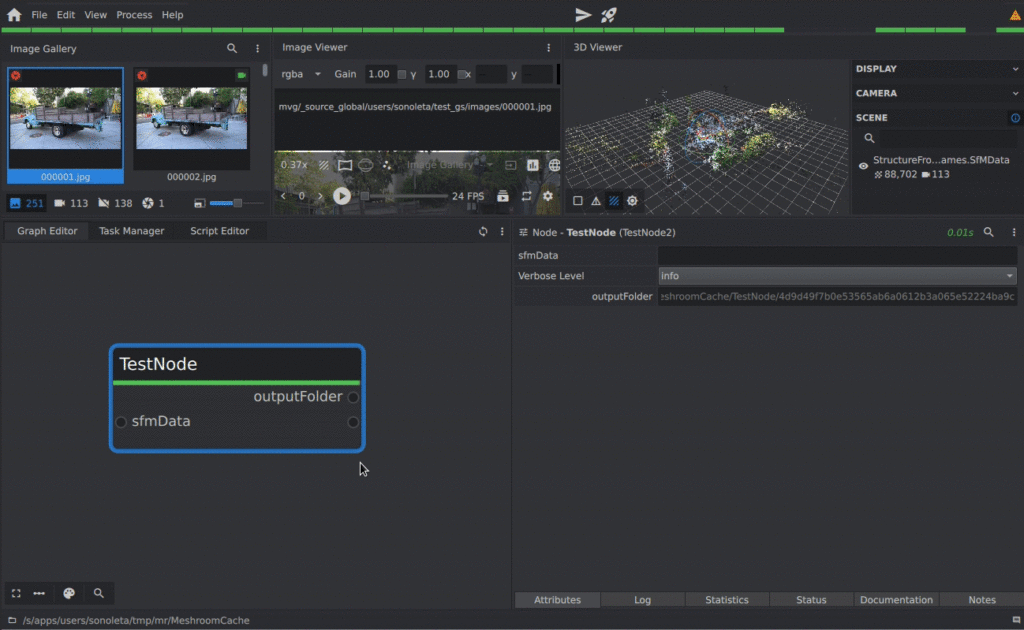
Meshroom is an open-source, node-based visual programming framework—a flexible toolbox for creating, managing, and executing complex data processing pipelines.
Meshroom uses a nodal system where each node represents a specific operation, and output attributes can seamlessly feed into subsequent steps. When a node’s attribute is modified, only the affected downstream nodes are invalidated, while cached intermediate results are reused to minimize unnecessary computation.
Meshroom supports both local and distributed execution, enabling efficient parallel processing on render farms. It also includes interactive widgets for visualizing images and 3D data. Official releases come with built-in plugins for computer vision and machine learning tasks.
Latest News
-
New Archaeological Digitization Tools in Partnership with French National Museum

As part of our partnership with the French Musée d’Archéologie National, ALICEVISION has integrated into Meshroom some enhancements for archaeological 3D digitization.By adding manual intervention tools when automatic methods fail, new features include 2D primitive drawing, manual anchor points for multi-image matching, improved 3D alignment of object fragments, and GLTF/GLB export for DPO Voyager integration. »
-
Open Source After Work

On Tuesday 09 December 2025 , Candice Bentéjac and Fabien Castan presented Meshroom at an open source after work event hosted by Cap Digital and co-organized by CST, and FICAM. The session concluded with engaging discussions among the attendees. See the full session (in French) here. »
-
Baptiste Brument Thesis Defense
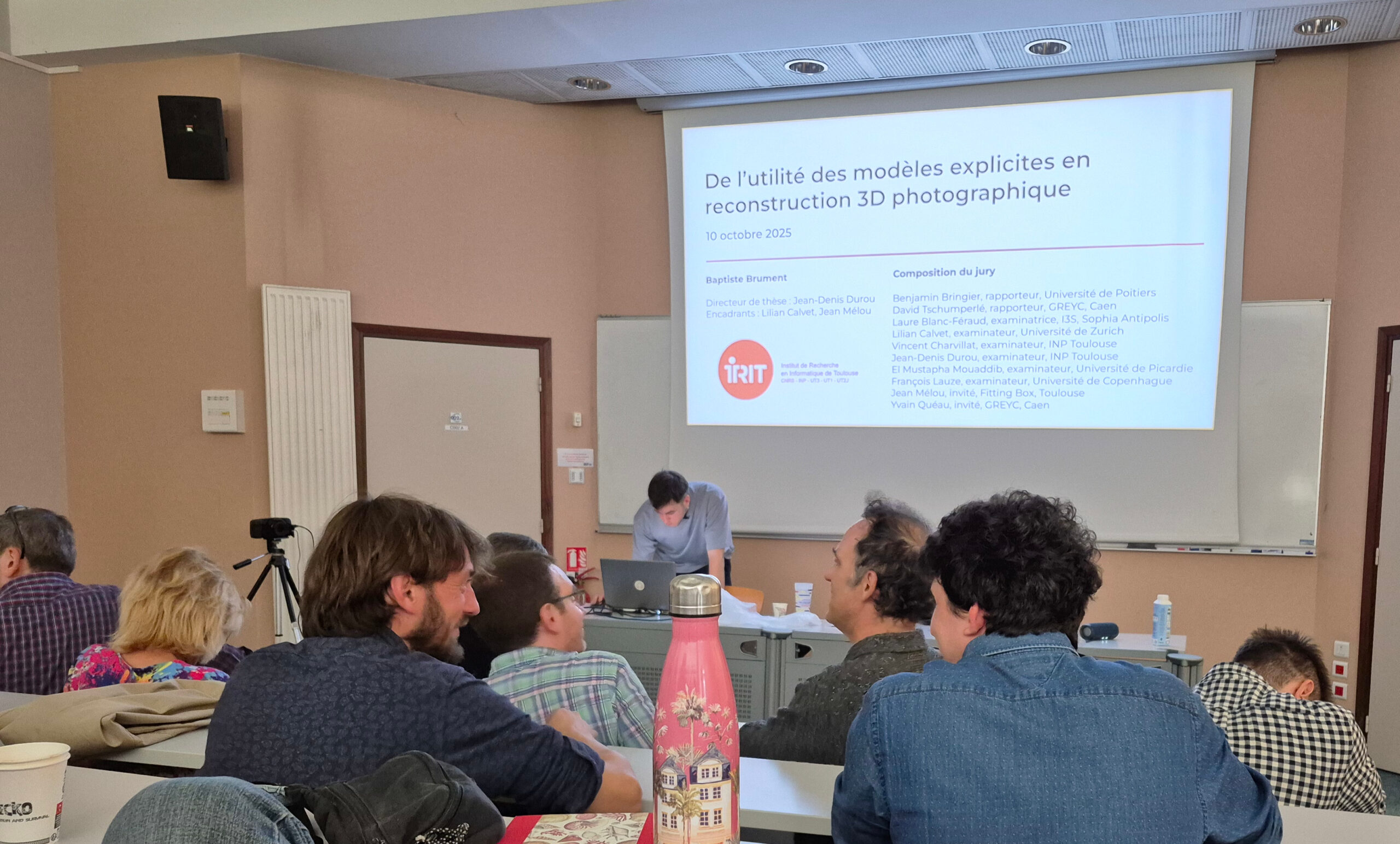
We are pleased to announce the PhD defense of a thesis dedicated to improving the robustness and accuracy of 3D reconstruction methods by integrating explicit models and leveraging physical (reflectance, shading, refraction) and geometric (gradients, silhouettes) properties. Rather than proposing entirely new approaches, this research enhances existing geometric and differentiable rendering frameworks, extending their applicability »